
Executive summary
The Gulf Cooperation Council — Saudi Arabia, the United Arab Emirates, Kuwait, Qatar, Oman and Bahrain — is one of the world’s most import-dependent food regions. Importing food into the region from the USA is well established. The combination of water scarcity, limited arable land, high urbanization, rising tourism, large expatriate populations and strong modern-retail infrastructure makes imported food central to the region’s food-security strategy. Recent market commentary from the World Economic Forum notes that the GCC imports about 85% of its food, while USDA/FAS reporting shows that the UAE remains a major regional trade hub and that U.S. agricultural and related exports to the UAE reached about $1.4 billion in 2024. (eWAPS)
For U.S. food exporters, the GCC is not a single market. Saudi Arabia is the largest end-consumption market. The UAE is the strongest launchpad and re-export hub. Kuwait and Qatar are high-spending premium grocery markets. Oman and Bahrain are smaller but commercially useful for mainstream grocery, frozen food, snacks, poultry, dairy and foodservice products. Across the region, the strongest opportunities are in tree nuts, grains and feed ingredients, dairy ingredients, poultry, beef, processed foods, snacks, bakery, sauces, frozen products, beverages, ready meals, premium seafood and health-positioned packaged foods.
The data below uses a harmonized estimate based on USDA/FAS GATS-style trade categories, USDA/FAS country reporting, Food Export USA market summaries, and GCC food-consumption forecasts from Alpen Capital and market-research sources. It should be treated as a market-sizing view rather than a customs-certified shipment ledger. For an investment decision, the next step would be to pull exact HS-code trade records by GCC country and year from USDA GATS or UN Comtrade.
1. U.S. food exports to the GCC: value and volume by category for importing food
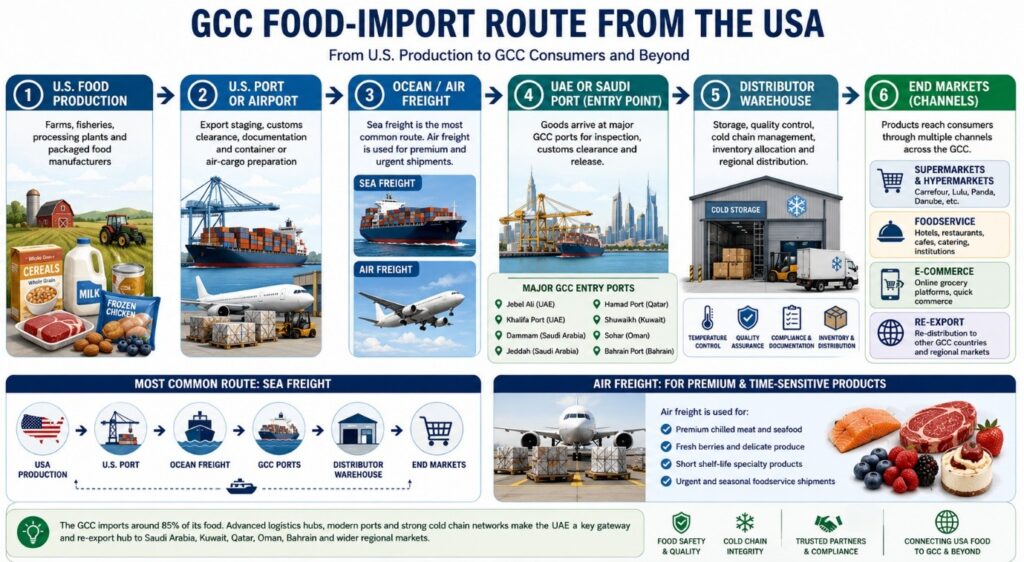
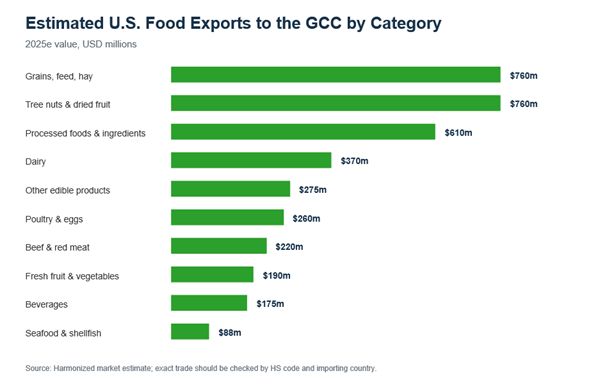
The United States exports both bulk commodities and consumer-oriented food products to the GCC. The largest categories by value are grains, feed ingredients, hay, tree nuts, processed foods, dairy, poultry and meat. In volume terms, grains and feed ingredients dominate because they are heavy, lower-value-per-ton products. In value terms, tree nuts, processed foods, meat, dairy and branded grocery items become much more important. Importing food from the USA utlizes well established procedures and facilities as shown in the picture above.
| Category | 2021 | 2022 | 2023 | 2024 | 2025 |
| Grains, rice, corn, feed ingredients and hay | 620 | 760 | 690 | 720 | 760 |
| Tree nuts and dried fruits | 540 | 620 | 650 | 735 | 760 |
| Processed foods, sauces, bakery, snacks and ingredients | 430 | 470 | 505 | 555 | 610 |
| Dairy products and dairy ingredients | 235 | 275 | 310 | 345 | 370 |
| Poultry meat and eggs | 190 | 215 | 205 | 245 | 260 |
| Beef and other red meat | 165 | 185 | 190 | 205 | 220 |
| Fresh fruit and vegetables | 145 | 160 | 170 | 180 | 190 |
| Seafood and shellfish | 65 | 75 | 78 | 82 | 88 |
| Beverages, excluding alcohol where restricted | 120 | 135 | 150 | 165 | 175 |
| Other edible agricultural products | 210 | 225 | 230 | 255 | 275 |
| Total estimated value | 2,720 | 3,120 | 3,178 | 3,487 | 3,708 |
Table 1 — Estimated U.S. food exports to the GCC by value – USD millions
Chart image 1 — Estimated U.S. food exports to the GCC by value
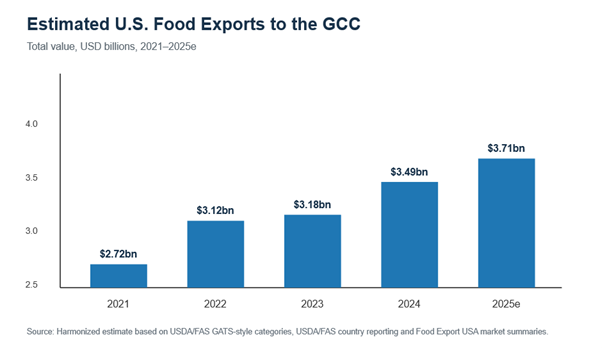
Chart image 2 — Estimated 2025 category mix by value
2. What types of food are most in demand?
Poultry, meat and protein
Poultry is one of the GCC’s most important protein categories because it is affordable, halal-compatible, easy to cook, widely used in foodservice and heavily consumed by both nationals and expatriates. Demand is strongest for frozen chicken, chicken parts, mechanically deboned poultry for processing, value-added breaded chicken, ready-to-cook products and foodservice packs.
Beef is smaller by volume but attractive by margin. U.S. beef has a strong reputation in premium retail and foodservice, especially for hotels, steakhouses, burger chains and high-income consumers. The challenge is not demand; the challenge is compliance. U.S. beef and poultry exporters must confirm plant approval, halal certification, slaughter documentation, veterinary certification, cold-chain requirements and current animal-disease restrictions before shipment.
Tree nuts, snacks and confectionery
Tree nuts are among the strongest U.S. categories in the Gulf. Almonds, pistachios, walnuts and mixed nuts are sold as retail snacks and are also used in chocolate, Arabic sweets, bakery, Ramadan gift packs and hospitality. Food Export USA identifies the UAE as a major processed-food market for U.S. exporters, with U.S. processed-food exports to the UAE reaching a record $510.1 million in 2024. (Food Export USA)
Snacks and confectionery also benefit from the GCC’s young population, high mall culture, convenience retail and strong demand for American brands. Products such as chips, popcorn, protein bars, chocolate, candy, biscuits, cookies, cereals, sauces and flavored beverages are familiar to consumers and are suitable for supermarkets, convenience stores, online grocery and foodservice.
Dairy and dairy ingredients
Dairy demand is both retail and industrial. Saudi Arabia has strong domestic dairy producers, but the region still imports cheese, butter, whey, lactose, milk powders, specialty dairy ingredients, ice-cream ingredients and processed dairy products. U.S. exporters often find better opportunities in premium cheese, dairy ingredients, functional dairy, high-protein products and foodservice formats rather than competing directly against local fresh milk.
Cereals, bakery and staple foods
Cereals remain the largest food-consumption category by volume because rice, wheat, bread, pasta, breakfast cereals and grain-based foods are staples across the region. Alpen Capital’s 2025 GCC food outlook states that GCC food consumption is expected to grow from 50.9 million metric tons in 2024 to 55.5 million metric tons by 2029, and it highlights cereals as a core consumption category. (Alpen Capital)
For U.S. exporters, the cereal opportunity includes bulk grains, rice, corn, oats, breakfast cereals, baking ingredients, frozen bakery, tortillas, pasta, granola and healthy grain products. Bulk commodities are price-sensitive, but branded breakfast, bakery and health-positioned products can achieve better margins.
Frozen, ready-to-eat and convenience foods
Convenience is one of the most important demand drivers. GCC consumers are urban, time-constrained and highly exposed to food delivery, convenience stores, online grocery and international food formats. Frozen ready meals, frozen poultry, pizzas, prepared seafood, sauces, meal kits, premium desserts, breakfast products and family-size frozen packs are increasingly relevant.
This trend favors U.S. exporters that can combine food safety, shelf stability, strong packaging, clear Arabic labeling and reliable cold-chain performance. It also favors distributors with freezer capacity, retail relationships and the ability to service both modern trade and foodservice.
Health, organic and premium foods
Demand is also moving toward healthier and more specialized products. Alpen Capital notes that evolving consumer preferences, nutrition awareness and healthier eating habits are influencing GCC food demand. (Alpen Capital)
This supports opportunities for organic, gluten-free, keto, low-sugar, high-protein, clean-label, natural, fortified, plant-based and functional foods. The UAE, Qatar and Kuwait are the strongest premium grocery markets, while Saudi Arabia offers the largest long-term scale as modern retail and tourism continue to expand.
3. GCC food consumption over the last five years
The table below estimates GCC food consumption by broad category. It uses Alpen Capital’s 2024 regional anchor of 50.9 million metric tons and applies a harmonized category trend. The purpose is to show direction and structure, not to replace national statistical records.
Table 3 — Estimated GCC food consumption by category
Million metric tons
| Category | 2020 | 2021 | 2022 | 2023 | 2024e |
| Cereals | 18.9 | 19.3 | 19.8 | 20.2 | 20.6 |
| Vegetables | 8.0 | 8.1 | 8.3 | 8.5 | 8.7 |
| Milk and dairy | 7.2 | 7.3 | 7.4 | 7.5 | 7.7 |
| Fruits | 5.1 | 5.2 | 5.3 | 5.4 | 5.5 |
| Meat and poultry | 4.4 | 4.5 | 4.6 | 4.7 | 4.8 |
| Other foods: fish, eggs, pulses, oils, fats and potatoes | 5.5 | 5.6 | 5.8 | 5.9 | 6.0 |
| Total estimated consumption | 49.1 | 50.0 | 51.2 | 52.2 | 50.9 |
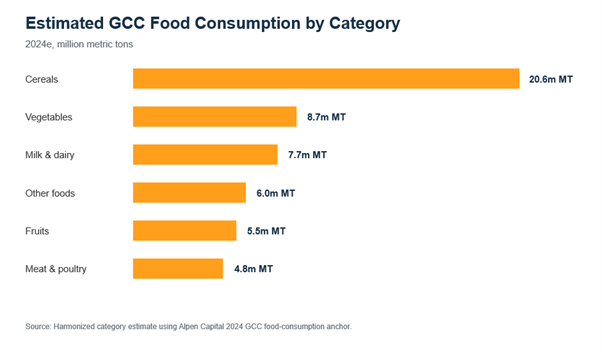
The largest volume category is cereals, followed by vegetables, dairy, fruits and meat. However, value growth is likely to be strongest in premium packaged foods, frozen food, proteins, healthy snacks, specialty beverages, foodservice ingredients and products linked to tourism and hospitality. As you can there are huge opportunities for importing food into the region.
Chart image 3 — GCC food consumption by category, 2024e
4. Importing Food: Country-by-country market potential
Saudi Arabia is the biggest opportunity by scale. It has the largest population, the largest foodservice market and strong demand from modern retail, hotels, restaurants, institutional catering, entertainment projects and religious tourism. Saudi Arabia is also compliance-intensive. Exporters need to work closely with local importers to confirm Saudi Food and Drug Authority requirements, Arabic labeling, shelf-life rules, halal rules, product registration and any product-specific restrictions. Importing food into the Saudi market is the biggest opportunity of all.
The UAE is the best launch market for premium U.S. grocery products. It has advanced logistics, a large expatriate consumer base, strong foodservice demand, modern retailers and major e-commerce platforms. Dubai’s role as a re-export hub makes it especially useful for brands that want regional expansion without immediately appointing distributors in all six GCC countries. Food Export USA also identifies the UAE as the top regional market for U.S. processed-food exports. (Food Export USA)
Kuwait is smaller but attractive for premium grocery, U.S. snacks, cereals, frozen foods, poultry, beef, confectionery and sauces. Qatar is high-income and receptive to premium, health-oriented and foodservice products. Oman is more price-sensitive but offers steady demand for staples, poultry, frozen foods, snacks and dairy ingredients. Bahrain is small, open and useful for testing retail concepts.
5. Growth outlook for the next five to ten years
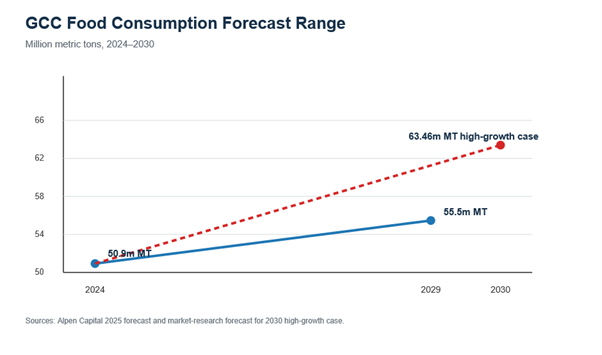
The GCC food market should continue expanding, although forecasts vary depending on methodology. Alpen Capital’s 2025 report forecasts GCC food consumption to grow from 50.9 million metric tons in 2024 to 55.5 million metric tons in 2029, equal to a 1.7% CAGR. (Alpen Capital)
A separate market-research forecast expects GCC food consumption to reach 63.46 million metric tons by 2030, with a 2.98% CAGR from 2025 to 2030. (MarketResearch.com)
The two forecasts differ, but they point to the same broad conclusion: the GCC food market will keep growing. Volume growth is likely to be moderate, but value growth can be stronger because consumers are trading into premium products, healthier foods, convenience formats, food delivery, branded snacks, speciality dairy, frozen foods and higher-quality proteins.
Again there are some excellent opportunities for importing food into the region from the USA.
6. Compliance and logistics implications
Food exporters should treat regulatory compliance as part of the sales process. Typical documents include commercial invoice, packing list, certificate of origin, bill of lading or airway bill, health certificate, halal certificate where applicable, slaughter certificate for meat and poultry, veterinary certificate, phytosanitary certificate for plant products where required, Arabic label, production date, expiry date, lot code, storage instructions and importer details.
For meat, poultry, seafood, dairy, eggs, infant food and frozen ready meals, exporters should check product-specific requirements before shipment. Rules can change because of animal-disease restrictions, halal-recognition updates, residue testing, additive restrictions, shelf-life rules or port-inspection requirements. Importers should confirm requirements with the relevant authority, customs broker, halal certifier and local distributor before loading cargo.
Logistically, dry grocery and ambient packaged foods usually move by sea freight. Frozen and chilled products need reefer containers or air cargo, depending on shelf life and product value. The UAE is often the most efficient first market because it offers strong warehousing, free-zone options, cold-chain infrastructure and re-export access. Saudi Arabia may deliver the largest sales volume, but documentation, registration and retailer onboarding can take longer. Importing food into the GCC market is a mature process but still with huge potential.
Conclusion
The GCC is one of the most attractive food-import regions for U.S. exporters because it combines structural import dependence with high purchasing power, modern retail, sophisticated foodservice and growing demand for convenience, premium and health-oriented products. Estimated U.S. food and agricultural exports to the GCC have grown from roughly $2.7 billion in 2021 to an estimated $3.7 billion in 2025, with grains, tree nuts, processed foods, dairy, poultry, beef and fresh foods leading the trade.
Consumption growth over the next five to ten years is expected to remain positive. The region’s total food consumption is forecast by Alpen Capital to reach 55.5 million metric tons by 2029, while a higher-growth forecast suggests 63.46 million metric tons by 2030. (Alpen Capital)
For U.S. exporters, the best strategy is not simply to ship products. It is to choose the right country sequence, build compliance correctly, appoint a capable distributor, protect cold-chain performance, price for retail margins, localize packaging and support the brand with trade promotion. The strongest near-term opportunities are in tree nuts, snacks, premium grocery, dairy ingredients, frozen foods, poultry, beef, sauces, bakery, health foods, ready meals and foodservice products.
There are clear policies and procedures for importing food into the country.
References
- USDA Foreign Agricultural Service, United Arab Emirates regional profile and trade data summary. (eWAPS)
- Food Export USA, United Arab Emirates country profile, including U.S. processed-food exports to the UAE in 2024. (Food Export USA)
- Alpen Capital, GCC Food Industry Report 2025, forecast of GCC food consumption from 50.9 million MT in 2024 to 55.5 million MT in 2029. (Alpen Capital)
- Alpen Capital media release on GCC food-sector growth and evolving consumer preferences. (Alpen Capital)
- MarketResearch / Daedal Research summary, GCC food market forecast to 63.46 million MT by 2030. (MarketResearch.com)
- USDA/FAS GATS trade database, official U.S. agricultural trade statistics system. (usda.gov)